
Treat Incheon as an alternative origin market, not as an automatic connection. Compare a through NGO→KZN fare, an ICN→KZN fare plus the Nagoya positioning trip, and a through Shanghai option on the same dates.
The August 2026 snapshot shows a much lower ICN fare level
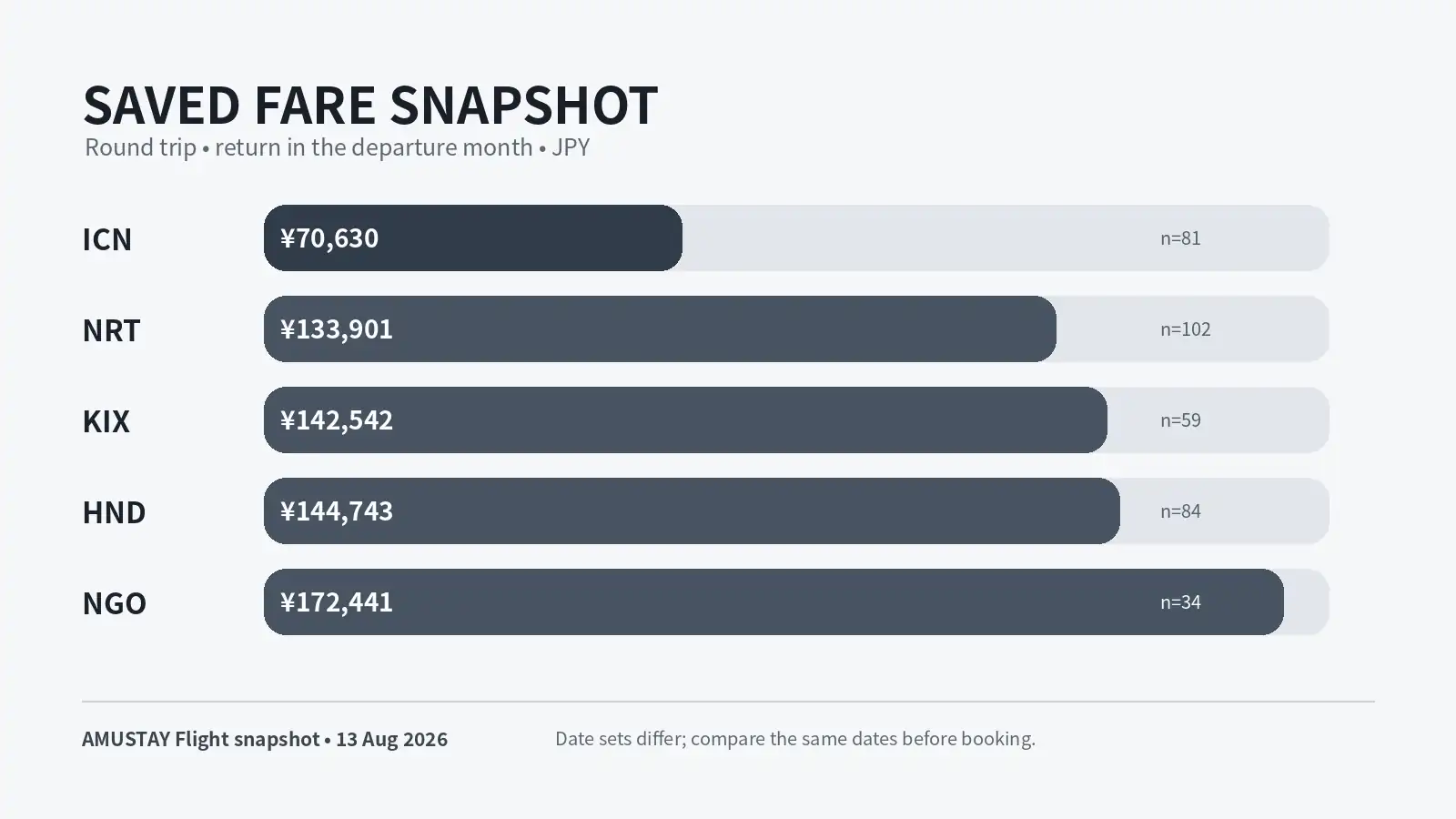
In AMUSTAY Flight’s 13 August 2026 snapshot, round trips returning in the departure month had 34 NGO→KZN observations with a ¥172,441 minimum and ¥197,795 average. ICN→KZN had 81 observations with a ¥70,630 minimum and ¥129,792 average.[1][2]
| Origin | Observations | RT minimum | Average | Observed departure dates |
|---|---|---|---|---|
| Incheon ICN | 81 | ¥70,630 | ¥129,792 | 13 Aug 2026–1 Mar 2027 |
| Narita NRT | 102 | ¥133,901 | ¥190,368 | 13 Aug 2026–31 May 2027 |
| Kansai KIX | 59 | ¥142,542 | ¥184,472 | 13 Aug 2026–28 Feb 2027 |
| Haneda HND | 84 | ¥144,743 | ¥195,258 | 14 Aug 2026–31 May 2027 |
| Nagoya NGO | 34 | ¥172,441 | ¥197,795 | 19 Oct–26 Dec 2026 |
The raw minimum gap is ¥101,811 and the average gap is ¥68,003. Those are not same-date comparisons: the Nagoya set is concentrated in October–December while ICN spans a wider window. Read the gap as a strong reason to price ICN separately, not as a guaranteed ¥101,811 saving.[1][2]
Same-date examples also showed ICN beating Japanese airports by ¥20k–¥37k
A 25 July 2026 AMUSTAY comparison matched Japanese origins and ICN on the same departure dates. It does not include Nagoya on those exact days, but it shows that the Korea-origin advantage was not only an artifact of different calendar windows.[3]
| Departure date | Japan-origin saved fare | ICN→KZN | ICN difference |
|---|---|---|---|
| 21 Nov 2026 | KIX ¥92,787 / HND ¥110,006 | ¥72,675 | -¥20,112 vs KIX / -¥37,331 vs HND |
| 8 Dec 2026 | HND ¥90,234 / FUK ¥92,341 | ¥54,885 | -¥35,349 vs HND |
| 1 Oct 2026 | NRT ¥93,880 / CTS ¥95,078 | ¥70,040 | -¥23,840 vs NRT |
A gap of this size can survive a cheap Nagoya–Incheon positioning fare. A ¥10,000 gap usually cannot justify the extra ticket, time and risk.
But “via Seoul” does not mean a simple ICN→KZN hop
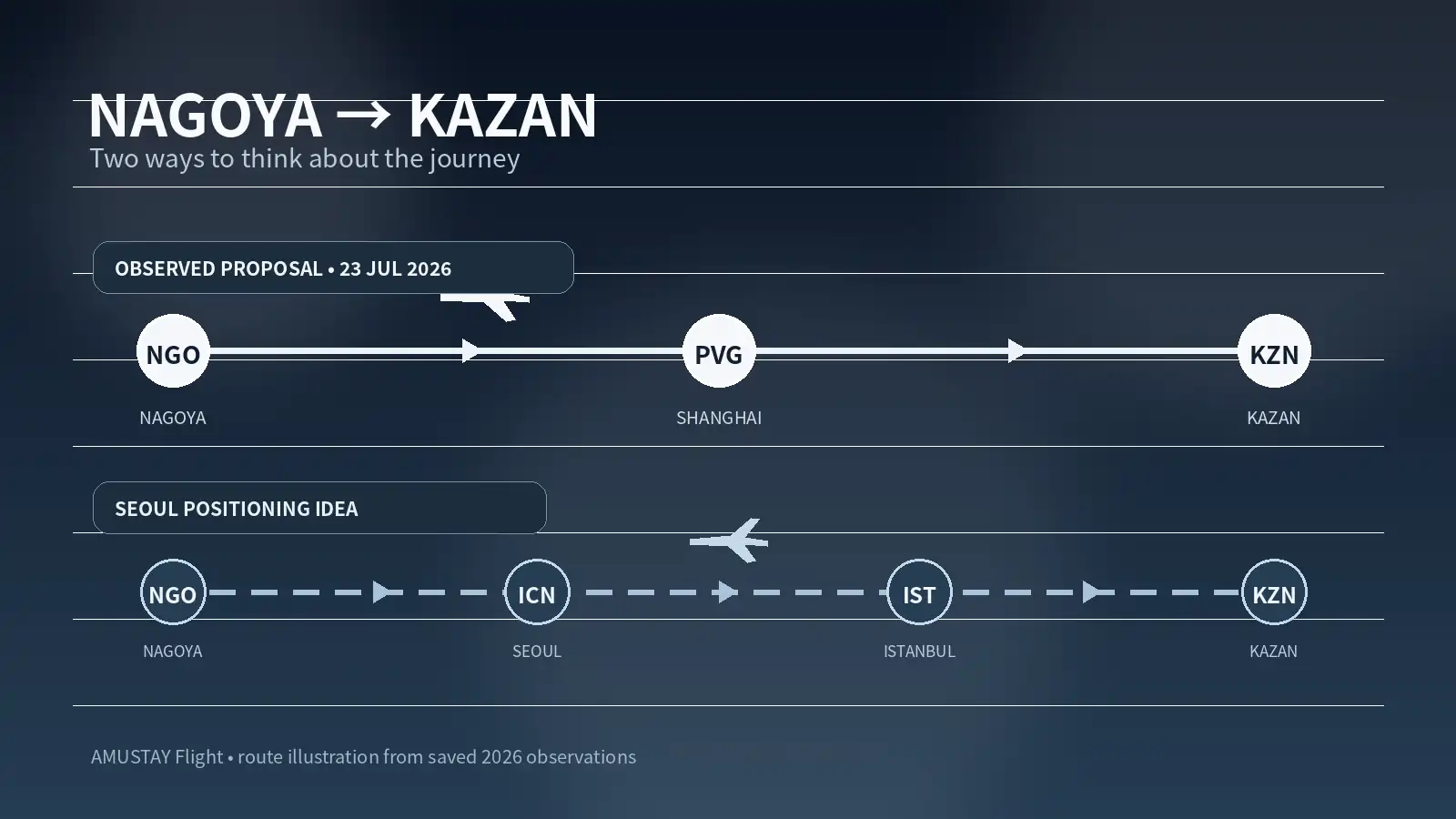
AMUSTAY’s saved Search API response from 23 July 2026 included NGO→ICN (19:00–20:55), ICN→IST and IST→KZN legs. The return-side data also contained KZN→IST→ICN and ICN→NGO candidates.[5]
That is the key conceptual point: Seoul works because you reposition into a different long-haul market. The onward itinerary may still go through Istanbul, making the trip substantially longer than the map suggests.
Shanghai is the strongest counterexample to making Seoul mandatory
The same 23 July search saved an actual ¥242,092 NGO↔KZN proposal. Outbound it ran NGO→PVG→KZN with one stop; the return ran KZN→SVO→PVG→NGO. NGO→PVG and PVG→KZN were recorded as China Eastern MU530 and MU5065.[4]
¥242,092 is a dated search result, not a current fare benchmark. Its value is structural: a single Nagoya search really did produce a one-stop outbound to Kazan via Shanghai. If the Seoul strategy requires a separate ticket, an overnight stay and then Istanbul, a slightly higher through fare via PVG can be the better trip.
The Seoul break-even equation
Compare that total with a through NGO→KZN fare for the exact same dates. The large aggregate gap in the August snapshot is a useful signal, but not money you can automatically spend on positioning.[1][2]
- Price a through NGO→KZN round trip first.
- Price ICN→KZN on exactly the same travel dates.
- For separate tickets, prefer arriving in Incheon the previous day instead of relying on a short same-day connection.
- Add checked baggage, hotel, airport transport and re-check-in time.
- Keep a through PVG option in the comparison and weigh total elapsed time and connection protection.
If you actually want Seoul, the economics change
A Seoul overnight is not pure connection cost if Korea is part of the holiday. For a traveler who wants one or two days of food, shopping or sightseeing in Seoul, the positioning segment creates travel value as well as cost.
If your only goal is to reach Kazan quickly, Seoul is a detour. In that case a one-stop through itinerary via Shanghai can justify a higher headline fare.
Who should consider the Seoul strategy?
| Good fit | Poor fit |
|---|---|
| You want 1–2 days in Korea | You want the fastest trip to Kazan |
| ICN is tens of thousands of yen cheaper | The fare gap is small |
| You can leave a large buffer between tickets | Only a tight same-day connection works |
| Light baggage / flexible fare comparison | Heavy checked baggage |
| You enjoy multi-city trips | You want the fewest possible connections |
Conclusion: use Seoul as an alternative origin market
Incheon’s real advantage is not geography; it is that ICN→KZN can price materially below Japan-origin markets. AMUSTAY’s broad 2026 snapshot and same-date examples both support that.[2][3]
But Seoul can add a separate ticket and another hub, while AMUSTAY has a real NGO→PVG→KZN one-stop outbound example.[4][5] The practical comparison is therefore three-way: Nagoya through fare, ICN fare plus positioning, and a Shanghai through fare on the same dates.
Frequently asked questions
Is Nagoya to Kazan cheaper via Seoul?
Sometimes. AMUSTAY saved fares show several periods where ICN→KZN was materially cheaper than Japan-origin fares. Add NGO→ICN, hotel, baggage and separate-ticket risk before deciding.
Can I assume Incheon to Kazan will be a simple direct onward flight?
No. AMUSTAY’s saved 2026 search data included an Incheon–Istanbul–Kazan chain. ICN can be a cheaper origin without being the shortest route.
Should I self-connect in Incheon on the same day?
With unprotected separate tickets, arriving the previous day is the more practical baseline. It leaves room for delay, immigration, baggage collection and re-check-in.
Should I also compare Shanghai?
Yes. AMUSTAY has a real 2026 search example with NGO→PVG→KZN in one stop outbound.
Sources
- [1]AMUSTAY Flight — in-house saved-fare snapshot, 13 Aug 2026NGO→KZN same-month RT n=34 min ¥172,441 avg ¥197,795; next-month RT n=79 min ¥169,456 avg ¥202,135.
- [2]AMUSTAY Flight — in-house saved-fare snapshot, 13 Aug 2026ICN→KZN OW n=509 min ¥51,052 avg ¥71,451; same-month RT n=81 min ¥70,630 avg ¥129,792; includes NRT/KIX/HND comparisons.
- [3]AMUSTAY Flight — same-date airport comparison snapshot, 25 Jul 2026Japan-origin vs ICN→KZN examples for 21 Nov, 8 Dec and 1 Oct 2026.
- [4]AMUSTAY Flight — saved Aviasales / Travelpayouts Search API observation, 23 Jul 2026¥242,092 NGO↔KZN proposal: outbound NGO→PVG→KZN; return KZN→SVO→PVG→NGO.
- [5]AMUSTAY Flight — saved Search API flight-leg observation, 23 Jul 2026NGO→ICN, ICN→IST, IST→KZN and return-side KZN→IST→ICN→NGO candidates.